Disclosure: Some links in this article are affiliate links. If you sign up through one of them, we may earn a commission at no extra cost to you. Our opinions are our own, and we point out where a different tool fits better.
This REimagineHome review answers the three questions agents ask before paying for an AI staging tool: what does it cost per listing, does it hold up on the MLS, and is it better than the cheaper alternatives? Short answer: it is a strong pick if you stage two or more listings a month, and an expensive habit if you stage one listing a quarter. The sections below show exactly where that line sits, including a worked cost example you can re-run with your own numbers.
How this REimagineHome review was built: from REimagineHome’s published plans and feature descriptions plus independent 2026 reviews, not from a long-term hands-on test. The tool offers free designs with no card required, so the fastest way to settle the quality question is to run one of your own listing photos through it before you pay anything. For a side-by-side with other tools, see our best virtual staging software guide.
Quick Verdict: REimagineHome Review in 60 Seconds
Question
Answer
Best for
Agents staging 2+ listings a month who want MLS-safe staging plus exterior cleanup in one tool
Price range
$14–$99/month, credit-based (see the pricing section below)
Free option
Yes — a few free designs, no credit card required (as reported by independent reviews)
Strongest points
Realistic lighting and shadows, structure stays untouched in staging mode, shoppable furniture, chat refinements cost no credits on Pro and above
Weak points
Monthly credits expire, chat editing is not on the entry plan, limited precision control
Skip it if
You stage less than one listing every two months (pay per image instead) or need hand-edited luxury hero shots
What REimagineHome Is (and Who Built It)
REimagineHome is an AI virtual staging and redesign platform built by Styldod, a company with a background in real estate media and virtual staging services. Independent reviews put it at more than 1.5 million registered accounts, with real estate agents among the biggest user groups. You upload a room photo; the AI furnishes it, clears clutter, or restyles it in seconds. Only final renders use credits.
REimagineHome Review: What You Actually Get
Virtual staging for empty and furnished rooms
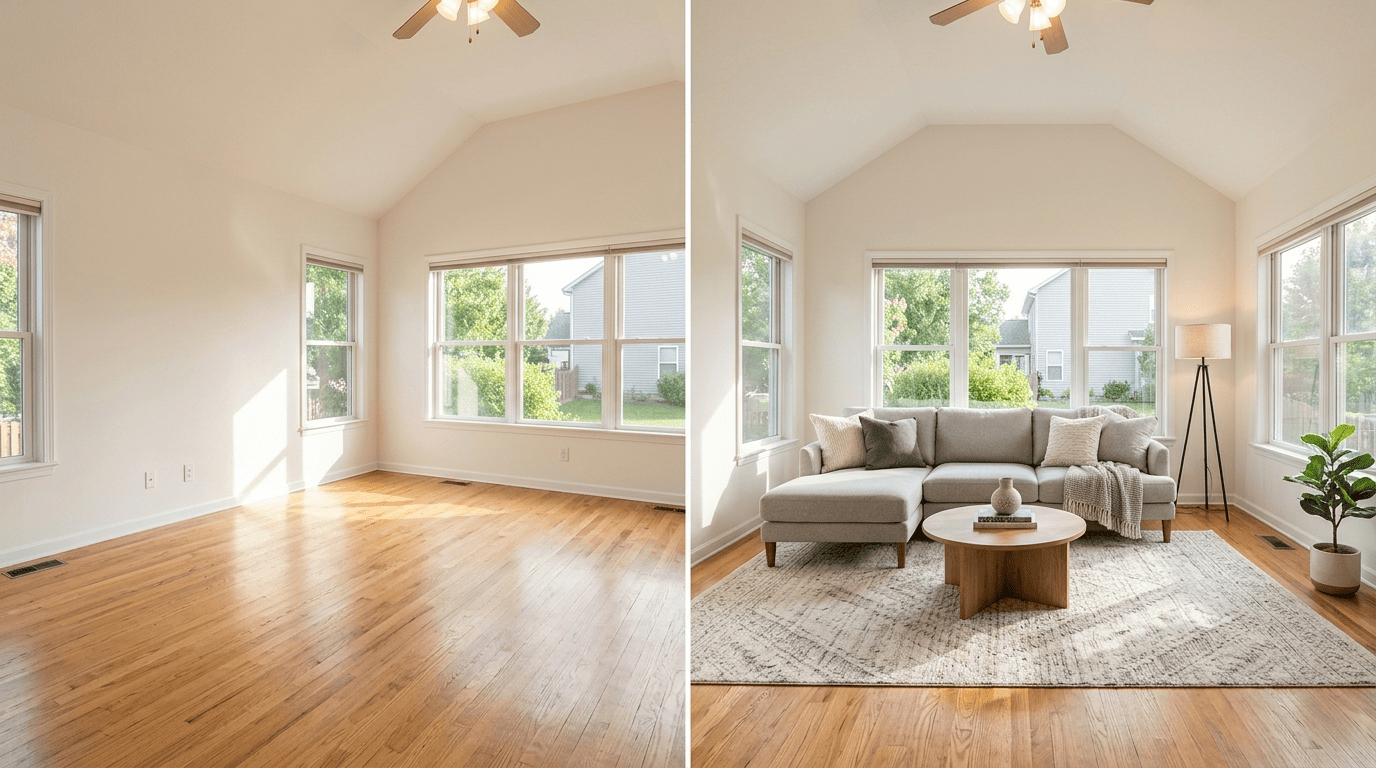
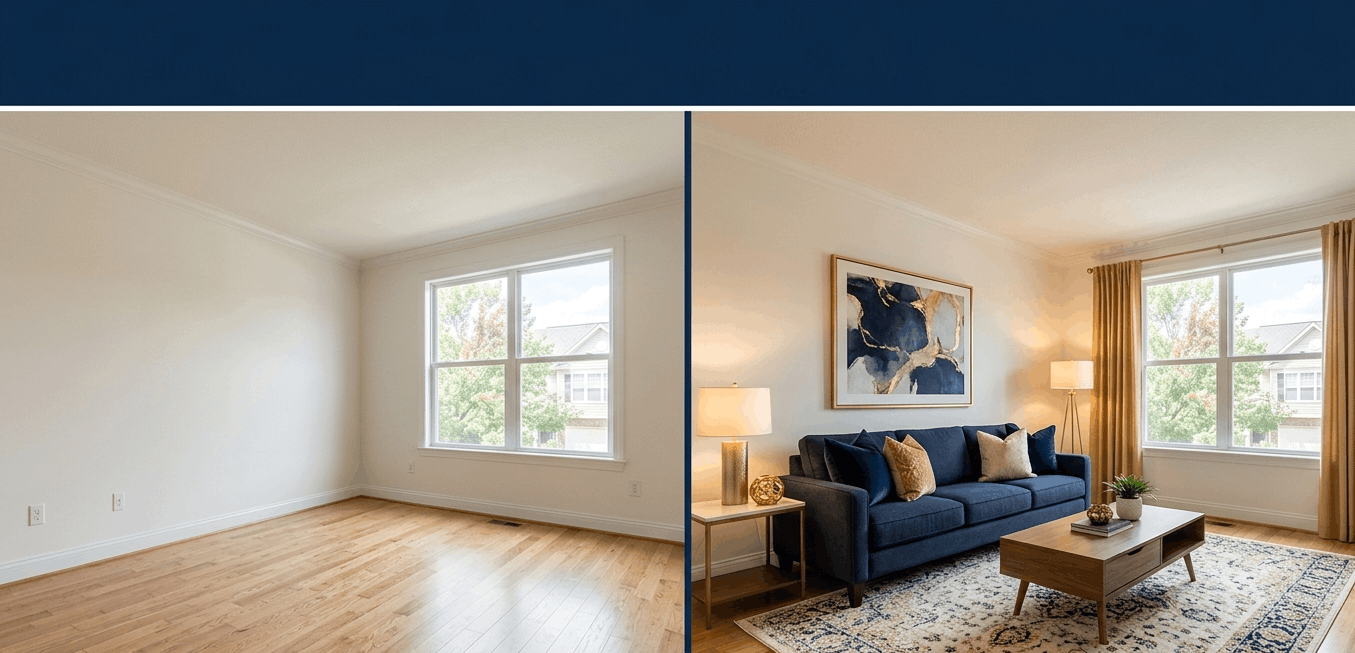
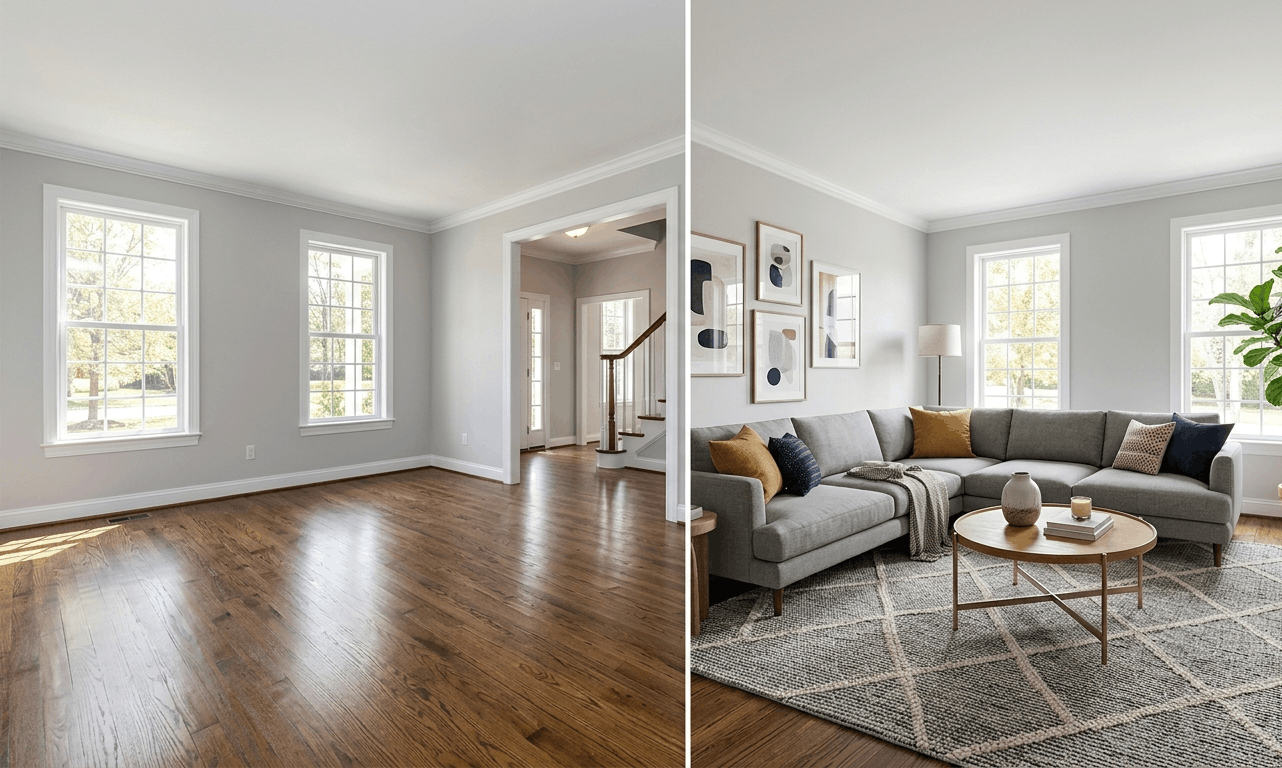
The core feature. Upload a photo, pick a style, and the AI adds furniture and decor on top of the real room. Independent reviews consistently note that walls, windows, and ceiling lines stay untouched, which is the single most important property for MLS use.
Decluttering and object removal
Clears personal items and clutter from furnished rooms. Useful on listings where the seller is still living in the home and you need clean photos without asking them to repack.
Exterior tools
Sky replacement, lawn enhancement, and day-to-dusk lighting are listed in reviews. Exterior photos decide first-click behavior on listing portals, so having these in the same subscription as staging saves a separate tool.
Conversational editing (Pro and above)
Describe a change in plain language and the AI regenerates, for example swapping cabinets or changing a wall color. Reviews report that chatting and exploring ideas costs no credits; only the final render does. One caution: remodel-style edits show what a room could look like, not what it is. Use them for seller presentations, never for MLS photos.
Real product discovery
Staged furniture can be tied to real, shoppable products from retailers such as IKEA, Target, and Wayfair, and you can set budget and ZIP code. For agents it is a talking point with buyers and sellers more than a daily workflow feature.
Batch processing
Higher plans let you process up to 50 photos in one pass. Check which plan your pricing page lists this under, since third-party sources disagree on the tier.
REimagineHome Pricing in 2026: How Credits Work
REimagineHome sells monthly credit allowances, not unlimited staging. Here are the plans as widely reported in August 2026 reviews, with the cost per credit worked out so you can compare plans fairly:
Plan
Monthly price
Credits / month
Cost per credit
Best for
Essential
$14
30
~$0.47
1–2 listings a month, no chat editing
Pro
$49
200
~$0.25
3–16 listings a month, chat editing, real product discovery
Advanced
$74
400
~$0.19
Busy solo producers and small teams
Agency
$99
900
~$0.11
Teams and high-volume offices
Plans and credit allowances change. Confirm the current numbers on REimagineHome’s pricing page before you subscribe, then plug them into the formula used throughout this review: price ÷ credits = cost per credit.
How credits behave, per independent reviews:
Only final renders consume credits. Chatting and idea exploration is free on plans that include conversational mode.
Monthly credits expire at the end of each billing cycle. There is no rollover, so a quiet month is money spent on nothing.
The entry plan uses the older tool set without chat refinement.
New accounts get a few free designs to test quality. Start there on a real listing: try REimagineHome free.
REimagineHome Review Worked Example: What Staging Really Costs per Listing
Pricing tables hide the real question: how many credits does a finished listing burn? Here is the math for a solo agent we will call Dana, who lists three homes a month.
Assumptions: Dana stages 6 photos per listing (living room, dining room, primary bedroom, two secondary bedrooms, home office). She needs about 2 renders per photo to get one she is happy with. We assume 1 credit = 1 render, which independent reviews describe but you should confirm on your own account during the free designs.
Essential plan (30 credits): 6 credits short. To stay inside it, Dana would need to average 1.7 renders per photo (30 ÷ 18). Cost per delivered photo: $14 ÷ 18 = $0.78.
Pro plan (200 credits): covers the month with 164 credits left over, and those expire. Cost per delivered photo: $49 ÷ 18 = $2.72.
Human-edited comparison: 18 photos × $30 per image = $540 a month. Pro saves $491 (about 91%). Essential saves $526 (about 97%).
Dana’s decision: Essential works only if she is disciplined about re-rolls. Pro costs $35 more a month (which buys 170 extra credits and conversational editing) and removes the credit counting. A simple rule: pick the cheapest plan whose credits cover your expected renders plus a 25% buffer. Dana needs 36 × 1.25 = 45 credits, so by that rule she lands on Pro.
The same math, stretched across plans, shows where each tier stops making sense. This assumes 12 credits per listing (6 photos × 2 renders):
Plan
Listings covered per month
Cost per listing if you use every credit
Essential ($14)
2.5
$5.60
Pro ($49)
16.7
$2.94
Advanced ($74)
33.3
$2.22
Agency ($99)
75
$1.32
Read the last column carefully: those costs only apply if you actually use the credits. Dana on Pro uses 36 of 200, so her real cost per listing is $49 ÷ 3 = $16.33, not $2.94. Credits that expire are the hidden cost of every higher tier.
Your move: stage your first real listing on the free designs, write down how many credits it used per keeper photo, and replace my assumption of 2 renders per photo with your actual number. That one figure decides your plan.
MLS Rules: What You Must Do With Any Staged Photo
The tool cannot do compliance for you. Four habits cover most of the risk:
Label every staged photo as virtually staged and add a disclosure line in the listing remarks. Exact wording varies by MLS, so ask your broker for your board’s rule.
Keep the original, unedited photo on file so you can produce it if a buyer questions the image.
Never use remodel-style outputs (new cabinets, flooring, wall changes) in MLS photos. Staging adds furniture; remodeling shows things that do not exist.
Best for: agents staging two or more listings a month who want realistic, MLS-safe staging plus exterior cleanup under one subscription, and who will use their credits before they expire.
Not for: agents staging less than one listing every two months (a per-image service costs less over a year), agents who need hand-edited polish on $2M+ listings (use a human-edited service for those hero shots), and anyone who hates counting credits (a photo-capped plan may suit you better).
How to Stage Your First Listing With REimagineHome (7 Steps)
Menu names may differ slightly as the product updates, but the workflow holds:
Start on the free designs with one real listing photo. No card needed.
Upload the original, straight-on photo. If the room is furnished and you want it empty, declutter first.
Pick a style that matches the buyer in that neighborhood. Keep it simple; neutral beats clever.
Generate, then compare the render against the original. Walls, windows, doors, and flooring must be unchanged.
Re-roll or refine (chat on Pro and above). Track how many credits each keeper photo costs.
Download the high-resolution file and add a clear “virtually staged” label.
Upload to the MLS with the disclosure in the remarks, and save both the original and staged versions in one folder.
The credits used on that first listing are the number that replaces my assumption in the worked example above.
Which REimagineHome Plan Should You Pick?
Match your monthly listing volume to a plan using the coverage table above (12 credits per listing):
Your situation
Start with
Testing, or fewer than 1 listing a month
Free designs first, then Essential. Under one listing every two months, a per-image service is cheaper.
1–2 listings a month
Essential, if you can live without chat editing
3–16 listings a month, or you want chat editing
Pro
17–33 listings a month, or a small team
Advanced
Team or brokerage batches
Agency
4 Mistakes That Waste Credits
Buying Pro for credits you never use. Credits expire monthly. Pay for the features you need, not for headroom you will not touch.
Staging every photo. Stage the four to six rooms that sell the layout (living, dining, primary bedroom, flex space). Bathrooms and closets rarely earn their credits.
Putting remodel outputs on the MLS. Keep those for seller presentations.
Skipping the original-versus-render check. Floating furniture and altered fixtures are what get listings flagged.
Frequently Asked Questions
Is REimagineHome free?
New accounts get a few free designs with no credit card, according to independent reviews. Paid plans run from $14 to $99 a month.
Is REimagineHome allowed on the MLS?
Most MLS systems allow virtual staging with disclosure, and the tool keeps the room structure intact in staging mode. Rules vary by board, so label every staged photo, add the disclosure to your remarks, keep the originals, and confirm your board’s rule with your broker.
Do REimagineHome credits roll over?
Reviews report that monthly credits expire at the end of each billing cycle. Plan your tier around credits you will actually use.
How many credits does one staged photo use?
Reviews describe one credit per rendered output, with chatting and exploring free on conversational plans. Many photos need one to three renders, so test one listing and measure your own rate.
Is this REimagineHome review based on hands-on testing?
No. It is built from published plans, feature descriptions, and independent 2026 reviews, and it says so. Run the free designs on one of your own listings to confirm quality before paying.
Is REimagineHome better than Collov AI?
It depends on volume. Collov AI is built for very high listing counts at a lower monthly price. REimagineHome is the stronger pick when you want exterior cleanup, chat editing, and realistic lighting in the same tool.
The Bottom Line
The short version of this REimagineHome review: it pays for itself if you stage regularly and use your credits, and it wastes money if you do not. Run your first listing on the free designs, measure your real credits per keeper photo, pick the cheapest plan that covers that number plus a 25% buffer, and label every staged photo. Do those four things and the cost per listing stays in the single digits.
REimagineHome and all other product names mentioned are trademarks of their respective owners. This article is independent and is not sponsored by or endorsed by any company named. Pricing and feature information comes from public sources as of late summer 2026 and may have changed; confirm current details with each vendor and your local MLS before purchasing.
Disclosure: Some links below are affiliate links. If you sign up through one, we may earn a commission at no extra cost to you. We only recommend tools we believe genuinely help US real estate agents, and all opinions are our own.
The best AI virtual staging software turns an empty room into a warm, photographed-looking, buyer-ready space in seconds — for a few dollars instead of the hundreds or thousands physical staging costs. And in 2026, the quality jump is the real headline: the top tools now produce staging that’s genuinely hard to tell apart from a furnished room shot by a professional.
This guide focuses on the AI-first end of staging specifically — instant, DIY, and cheap. (For the full field, including traditional designer-led services, see our broader virtual staging software guide.) Here, the question is narrower and more practical: which AI tool gets you MLS-ready photos fastest, at the right price for how many listings you actually run?
Why AI Virtual Staging Is a No-Brainer in 2026
The economics aren’t close. AI staging runs roughly a few dollars per image; physical staging runs $800–$2,900 per property (often more in luxury markets). Studies have consistently found that staged listings tend to sell faster and for more than comparable empty homes — so you’re trading a few dollars for a real edge on price and days-on-market.
Speed is the second reason. The fastest AI tools stage a room in 10–60 seconds, which means you can shoot a vacant listing in the morning and publish fully staged photos to the MLS that afternoon. No furniture rental, no scheduling, no waiting.
The one rule you can’t skip: disclosure. AI-staged photos look real precisely because they are convincing — which is exactly why your MLS and the NAR Code of Ethics require you to disclose that photos are virtually staged (and usually to keep the originals). Done right, that’s a non-issue; we cover it in Section 4.
How We Compared These Tools — The 5 Criteria
Output realism. Does the result look like a real photographed room, or obviously AI? Shadows, reflections, and room proportions are where cheap tools fall apart.
Speed. Instant AI (seconds to a minute) versus human-edited turnaround (24–48 hours). For a listing on a deadline, speed is everything.
Pricing vs. volume. Per-image pricing wins at low volume; a monthly subscription wins once you’re staging several listings a month. The right tool depends on your deal flow.
Feature range. Just staging, or also furniture removal, decluttering, exterior/landscaping edits, renovation previews, and 360° tours?
MLS compliance support. Does it make disclosure easy — watermarks, before/after originals, compliance flags — so you stay inside the rules?
The Tools at a Glance
Tool
Best for
Pricing (2026)
Speed
Type
REimagineHome
All-around AI staging + decluttering + exteriors
$19–119/mo (free trial)
Under 1 min
AI-first
Virtual Staging AI
The fastest turnaround
Monthly plans / ~$16+ per image
~15 sec
AI-first
Collov AI
High volume on a tight budget
$19–39/mo (5 free images)
~10 sec
AI-first
Styldod
Luxury & complex listings, human-reviewed
$16–23/image (AI); human tiers
24–48 hr
Hybrid / human
BoxBrownie
Polished, human-edited at low volume
~$24/image
24–48 hr
Human
Two Routes: Instant AI vs. Human-Polished
The whole market splits cleanly in two, and picking your route first makes the rest of the decision easy:
Route 1 — Instant AI tools: REimagineHome, Virtual Staging AI, Collov AI. Photos back in seconds to a minute, for a few dollars each or a low monthly fee. This is where most agents should be in 2026.
Route 2 — Human & hybrid services: Styldod, BoxBrownie. A real editor (or AI plus human review) polishes each image over 24–48 hours. Slower and pricier per photo, but the right call for luxury listings where every detail has to be perfect.
Route 1: Instant AI Staging Tools
This is where most agents should be in 2026. These three stage a room in seconds to a minute, for a few dollars or a low monthly fee, with no design skill required. They’re the core of any list of the best AI virtual staging software — the differences come down to speed, extras, and price-per-volume.
REimagineHome is the one to try first, and it’s the easiest to recommend for agents new to AI staging. It was built by Styldod, a professional staging and photo-editing company, and its AI is trained on real staging projects rather than generic furniture catalogs — which shows up in the details that usually give AI away: shadow placement, reflections, and getting room proportions right. You pick from 50+ design styles, and the tool applies professional staging logic automatically, so you get polished results without any design knowledge.
What sets it apart is range. Most tools only stage; REimagineHome also declutters, removes furniture, edits exteriors and landscaping, and previews renovations — all under one credit pool. For prepping a vacant listing end-to-end (stage the interior, clear the clutter, clean up the front-yard photo), that’s the most efficient single subscription. It also flags compliance per photo, offers a human-assisted option, and has an API for brokerages. Pricing scales from $19/month (30 images) up to $119/month (1,200 images), with a free trial to test it.
The one catch: once you blow past your included credits, the per-image cost runs higher than the cheapest bulk tools. At extreme volume, a budget option may edge it out on price alone.
REimagineHome
Best for: Agents and teams who want realistic, MLS-ready staging plus decluttering and exterior edits in one tool — and the best starting point if you’re new to AI staging.
NOT for: Ultra-high-volume operations chasing the absolute lowest price per image, where a bulk-rate tool wins.
Virtual Staging AI — The Fastest
If your one need is “stage this empty room right now,” Virtual Staging AI is the quickest on the list — browser-based, no install, and roughly 15 seconds from upload to a furnished photo. It offers 50+ interior styles and requires zero design knowledge, and it handles occupied listings (not just vacant ones) more flexibly than most, which makes it the versatile pick when your photos aren’t all empty rooms.
The trade-off is breadth: it’s staging-focused, so you won’t find the same deep extras (exteriors, renovation previews, large credit pools) that REimagineHome bundles in.
Virtual Staging AI
Best for: Agents who prize raw speed and need a dead-simple, browser-based tool for both vacant and occupied listings.
NOT for: Agents who want one tool to also handle decluttering, exteriors, and renovation previews.
Collov AI — Best Value at Volume
Collov AI is the budget champion. At $19/month for the entry tier (with 5 free images to start) and around 10-second generation, the per-listing cost gets very low once you’re staging in volume — and reviewers consistently note its output doesn’t look obviously AI, which matters if brand aesthetic is part of your listings. It includes 50+ styles, unlimited free revisions, native furniture removal, and partnerships with furniture retailers so the staged pieces reflect real, shoppable products.
The limit is flexibility: style customization is more preset-constrained than the others, so if you want fine creative control over every placement, it’s not the tool.
Collov AI
Best for: High-volume agents on a tight budget who want clean, natural-looking staging fast.
NOT for: Agents who need granular creative control over styling and placement.
Bottom line for Route 1: for most agents, REimagineHome is the all-around pick — and the only one that takes a vacant listing from staged to decluttered to exterior-ready in one place. Choose Virtual Staging AI if pure speed wins, or Collov AI if you’re staging a lot of listings and watching every dollar.
Route 2: Human & Hybrid Services
Instant AI wins on price and speed — but for a luxury listing where every detail gets scrutinized, or a full virtual tour that has to stay consistent across angles, a human in the loop still earns its cost. These two are slower (24–48 hours) and priced per image, but they deliver a polish AI doesn’t always nail on the first try.
Styldod
BoxBrownie
Price
$16–23/image (AI); human tiers $24+
~$24/image
Turnaround
24–48 hours
24–48 hours
Standout
360° Matterport staging, renovation & 3D, human QA
Full human photo-editing suite
Best for
Luxury & multi-angle listings
Hands-off polish on occasional listings
Styldod — The Luxury & Hybrid Specialist
Styldod is a virtual staging pioneer — so established that its technology actually powers other apps, including REimagineHome. You can use its faster AI tier (around $16–23/image) or send a job to its human-review tier ($24+/image) when AI alone isn’t quite right, with 24–48-hour turnaround and unlimited revisions. The human QA is the point: it keeps a consistent style across every room and maintains visual continuity from angle to angle — which matters enormously on a high-end listing.
Its real differentiator is scope. Styldod is the one tool here that virtually stages 360° panoramic Matterport scenes, not just flat 2D photos, and it adds renovation visuals, floor plans, and 3D renders. For a luxury or architecturally complex property — especially one marketed with a virtual tour — that depth is hard to match.
The trade-offs are the obvious ones: it’s slower than instant AI, and the per-image cost adds up if you’re staging high volume.
Styldod
Best for: Luxury and architecturally complex listings, virtual-tour staging, and any job where multi-angle consistency and design judgment outweigh instant turnaround.
NOT for: High-volume agents who need photos back in seconds — that’s a Route 1 job.
BoxBrownie — The Hands-Off Polish
BoxBrownie is the go-to human-edited service for agents who’d rather hand it off than DIY. At around $24 per image with 24–48-hour turnaround, real editors do the staging — and because BoxBrownie is a full photo-editing house, you can get image enhancement, item removal, day-to-dusk conversions, and floor plans from the same place. For an agent who stages only occasionally and wants one trusted partner for all their listing photos, that’s a clean setup.
The catch is the same as any per-image human service: it’s slower and pricier than AI, so it doesn’t scale economically if you’re staging many listings a month.
BoxBrownie
Best for: Agents who stage occasionally and want hands-off, human-polished results — plus a one-stop shop for all their listing photo editing.
NOT for: High-volume staging, where per-image human pricing can’t compete with an AI subscription.
Bottom line for Route 2: these cost more and take a day or two, but for luxury listings, virtual tours, or anytime you want a human guaranteeing the result, the polish can be worth it. Pick Styldod for staging-specific depth and 360° work, BoxBrownie for a broader hands-off photo-editing partner.
AI vs. Physical Staging: The Honest Cost & ROI Math
This is the comparison sellers ask about, so it’s worth answering straight. The cost gap is enormous, but cost isn’t the whole story.
AI virtual staging
Physical staging
Cost
~$0.30–$24 per image
$800–$2,900+ per property
Speed
Seconds to 48 hours
Days to weeks
Helps your online photos
Yes — dramatically
Yes
Helps the in-person walkthrough
No — the home is still empty
Yes
Best for
Most listings; the online-first impression
Luxury / high-foot-traffic homes
For the vast majority of listings, AI virtual staging is the obvious call. Buyers start online — most decide which homes to even visit based on the photos — and a few dollars of staging that makes those photos sing is one of the highest-ROI moves in your marketing. Staged listings consistently tend to sell faster and for more than comparable empty homes, and AI gets you there for a rounding error against your commission.
But here’s the honest limit, because it matters: virtual staging only fixes the photos. When a buyer physically walks through, the home reverts to the empty, echoing space it actually is. For top-of-market properties with heavy foot traffic — where buyers need to sit on the sofa and feel the rooms — traditional physical staging at $1,500–$5,000 can still pull stronger offers. The smart play for most agents: AI-stage every listing for the online impression, and reserve physical staging for the premium homes where the in-person experience closes the deal.
The One Rule You Can’t Skip: Disclosure
AI staging works because it’s convincing — which is exactly why you have to be upfront about it. Under the NAR Code of Ethics, Article 12, agents must be honest and present a “true picture” in their advertising and marketing. Combined with individual MLS photo standards, that means virtually staged photos must be clearly disclosed (and most MLSs want the unedited originals available too).
In practice: label staged photos as “virtually staged,” keep the original empty-room shots, and never use AI to hide a defect or misrepresent the property. Done right, it’s a one-line caption — not a hurdle. For the full step-by-step on staying compliant, use the MLS staging disclosure checklist in our main virtual staging guide.
The Verdict: Which AI Virtual Staging Tool Should You Use?
There’s no single best AI virtual staging software — there’s the one that fits your volume, your listings, and how hands-on you want to be. Here’s the field matched to you:
For most agents, start with REimagineHome’s free trial — it covers the widest range of jobs and is the gentlest learning curve.
Save This: The 5–8 Photo Staging Plan for a Vacant Listing
You don’t need to stage every photo — staging empty rooms that already read as “complete” (kitchens, bathrooms) wastes money. Stage the rooms where buyers make emotional decisions, in this priority order:
Living room — your hero shot and the first room buyers picture themselves in. Always stage this.
Primary bedroom — the “this could be mine” room. Always stage.
Dining area — shows the home works for gathering and entertaining.
Secondary bedroom or home office — stage it as an office to capture remote-work buyers, or a kid’s room for families.
Outdoor space (patio/deck) — increasingly a deal-driver; stage it if the listing has one.
6–8. Optional: a bonus room/den, a second secondary bedroom, or a breakfast nook — add these for larger or higher-priced homes.
Skip or lightly style: kitchens and bathrooms (built-in cabinets and fixtures already make them look finished), plus hallways, closets, and the laundry room.
The cost math: at roughly $15–30 per image — or “free” inside a monthly subscription — a full 5–8 photo plan runs about $75–$240 per listing on per-image tools, and far less if you’re on a subscription. Against a commission, that’s nothing for photos that decide whether buyers book a showing.
The Bottom Line
AI virtual staging is one of the cheapest, highest-leverage moves in real estate marketing in 2026 — a few dollars to make a vacant listing look like a home buyers want to walk through. For most agents, REimagineHome is the all-around pick; reach for Virtual Staging AI when speed matters, Collov at high volume, and the human services (Styldod, BoxBrownie) for luxury listings. Whatever you choose: stage the rooms that sell, disclose that you did, and keep your originals.
Disclosure: Some links in this article are affiliate links. If you sign up through one of them, we may earn a commission at no extra cost to you. We only recommend tools we genuinely believe help US real estate agents, and all editorial opinions are our own.
Choosing the best virtual staging software for your listings in 2026 isn’t about finding the cheapest AI tool — it’s about matching the staging method to the listing. A $1.99 AI render works perfectly for a $300,000 starter home; a $30 human-edited BoxBrownie image earns its premium on a $3 million luxury listing where every shadow and texture matters. In this guide we compare the five most-used virtual staging and listing media tools for US agents in 2026 — REimagineHome, Collov AI, Apply Design, BoxBrownie, and Matterport — and match each one to the kind of listing it’s actually built for.
Why Virtual Staging Became Table Stakes in 2026
Five years ago, virtual staging was a luxury most agents skipped. Physical staging cost $2,000 to $5,000 per listing, and even the cheapest virtual staging services ran $50 to $100 per image, billed by hand-edited turnaround. So most agents either physically staged the home (expensive), shot it empty (boring), or stuffed the photos with awkward stock furniture in Photoshop (worse than empty). The math just didn’t justify staging most listings.
That math has completely collapsed in 2026. AI-powered virtual staging now ranges from $0.23 to $2 per image, while human-edited services like BoxBrownie charge $16 to $32 per room. For a typical 3-bedroom listing, an agent spends $5 to $50 total with an AI tool or $50 to $100 with a human-edited service. The price of staging one listing dropped by roughly 99% — and the agents who adapted are now staging every listing as a baseline expectation.
And it’s not just cosmetic. The data behind virtual staging is genuinely compelling. Homes with virtual staging sell up to 75% faster, and 83% close at or above asking price. BoxBrownie’s own research claims their photo enhancements help listings sell 50% faster. And for properties with 3D virtual tours specifically, listings spend 25–35% less time on the market and attract higher-quality leads, with luxury segments commanding measurable price premiums.
In other words: in 2026, an agent who shows up to a listing presentation without a staging plan is at a real competitive disadvantage. The cost is no longer the gate — the choice of which staging method is. Whether you’re staging the listing photos that go on your website and MLS, or building a 3D tour that supports your lead generation funnel, the right tool depends on the listing’s price point, your volume, and how much human polish the market expects.
The MLS Disclosure Reality You Can’t Skip
Here’s the part most “best AI staging” articles forget to mention. As AI virtual staging exploded in 2024 and 2025, MLS boards across the US tightened their rules sharply — and a virtually staged photo that isn’t properly disclosed can now get a listing flagged, removed, or get an agent in front of the broker review board.
The general rule in 2026 across most major MLS systems: any virtually staged photo must be clearly disclosed as such, both in the photo caption and in the listing remarks. The exact language varies by MLS, but the safe practice is to label virtually staged images with a visible watermark like “VIRTUALLY STAGED” in the corner of the photo, and add a disclosure line in the listing description.
Two other compliance points worth knowing:
Don’t alter structural elements. AI tools that change or remove fixtures, windows, walls, flooring, or cabinetry from the original photo cross the line from staging into misrepresentation. The best tools (REimagineHome, Apply Design) preserve room fixtures and structural elements by design.
Always keep the original photo on file. If a buyer ever raises a misrepresentation concern, you need to be able to show the original, unedited image.
The good news: the tools we recommend in this guide all handle compliance well when used correctly. The bad news: the tool can’t enforce it for you. You have to add the disclosure label and the listing-remarks line yourself.
Cut through the marketing pages and the differences come down to five things:
AI vs human. AI tools (REimagineHome, Collov, Apply Design) deliver a render in seconds or minutes for pennies. Human-edited services (BoxBrownie) take 24-48 hours and cost 10-100x more — but the polish on a luxury listing can be visibly worth it.
Per-image vs subscription pricing. BoxBrownie and Apply Design charge per image, which makes sense for low-volume agents (1-2 listings/month). Subscription tools (Collov, REimagineHome) make sense once you’re staging 10+ images per month.
Still images vs 3D tours. Most tools here produce staged still photos for MLS and your website. Matterport plays a different game — full immersive 3D walkthroughs that buyers explore room-by-room.
Photorealism and quality. Not all AI staging looks equally real. The cheapest tools sometimes generate floating furniture, mismatched lighting, or hallucinated room features. Premium tools (REimagineHome, Apply Design) match lighting and shadows convincingly.
MLS compliance built in. Does the tool preserve the original room structure (compliant) or generate idealized versions that drift from reality (risky)? This matters more than any other technical feature.
The 5 Best Virtual Staging Tools at a Glance
Tool
2026 pricing
Method
Speed
Best for
REimagineHome
$14–$99/mo subscription
Premium AI
Seconds
Multi-listing agents prioritizing quality
Collov AI
$19–$49/mo subscription
Budget AI
~10 seconds
High-volume agents (20+ listings/mo)
Apply Design
$7–$29 per image
Detail-control AI
~10 minutes
Luxury listings, careful detail control
BoxBrownie
$24–$30 per image
Human-edited
24–48 hours
Polished human quality, pay-per-image
Matterport
Free–$309/mo + tour fees
3D immersive tours
Per-property scan
Luxury, new construction, commercial
Notice the pattern: the more human polish (and the slower the turnaround), the higher the cost — but the lower the per-image cost gets, the more important MLS compliance discipline becomes. We’ll start with the platform most US listing agents end up choosing first in 2026: REimagineHome.
The Premium AI Tier: REimagineHome
This is the tool most US agents adopt first when they get serious about staging in 2026, and for good reason. It hits the sweet spot of price, quality, and compliance better than any other AI tool in the category — and unlike the budget options, it produces results that hold up under scrutiny from luxury buyers and tough MLS boards. If you’re staging more than two or three listings a month and want one platform you won’t have to second-guess, this is where to start.
REimagineHome — The Industry-Standard AI Virtual Staging Tool
REimagineHome has quietly become the default AI staging platform for serious US listing agents, and the industry is finally noticing. HousingWire named it the “Best overall AI virtual staging” tool for 2026, and the reasoning matches what working agents have been saying: the rendered results actually look like real photos.
The pricing is genuinely accessible. REimagineHome runs $14 to $99 per month across its subscription tiers, with priority support on the brokerage plans and what’s widely considered the strongest free trial in the category. The $14/month entry point makes it cheaper than even most budget tools when you factor in usage — and the $99/month brokerage tier is still less than the cost of staging a single luxury home with BoxBrownie.
What you get for the money is the most complete staging toolkit on the AI side of the market. The platform offers virtual staging, redesigning furnished rooms, landscaping, exterior structure rendering, and home remodeling visualization, plus customizations like lawn enhancement, sky replacement, and pool water enhancement. That last category matters more than you’d think — most AI staging tools only handle interiors, but exterior photos are where listings actually win the first-impression battle on Zillow and Realtor.com. Being able to clean up an overcast sky or refresh a tired front lawn in the same tool is a real workflow advantage.
The technical foundation is where it earns the “premium AI” label. The platform stands out for its ability to match lighting and shadows in staged photos, a crucial factor in creating lifelike images, and in professional tests, 70% of REimagineHome’s AI-generated outputs were downloaded, shared, or presented — a measure of how often the staged images are actually usable rather than discarded. For agents who’ve spent hours redoing renders from cheaper tools that produced floating furniture or mismatched lighting, that hit rate is the difference between “I’ll use it on every listing” and “I’ll keep it as a backup.”
Two specific features earn their place on a busy agent’s daily workflow:
Listing Batch Processing — High-volume real estate teams can stage and organize up to 50 photos at once through batch processing. For a team uploading 15+ MLS images per listing across multiple listings per week, this single feature can save hours.
Real Products Discovery — When the AI stages a room, the furniture and decor pieces shown are tied to real, shoppable products. For agents who want to send a staged room to a buyer and say “this couch and these lamps are available at these stores,” it’s a genuinely novel angle.
The platform is also where the cluster ties together — we featured REimagineHome in our AI tools guide and recommended it there too, so this is the deeper deep-dive on the tool itself.
What REimagineHome Actually Costs
Like every subscription tool, the headline number is the floor, not the ceiling. Here’s what an agent actually pays at different usage levels:
Tier
Best for
Approximate cost
Entry / Solo Trial
1–3 listings per month, testing the platform
$14/mo
Solo Standard
5–10 listings per month, regular staging workflow
~$49/mo
Brokerage / Priority
High-volume teams, batch processing, priority support
~$99/mo
Free Trial
Try before subscribing
Free (no credit card required)
At any of these price points, the math on staging a single listing makes the tool pay for itself the first time it shortens days-on-market by even a week. The honest comparison isn’t “REimagineHome vs Collov AI on price per image” — it’s “what does an unstaged photo on your $400,000 listing cost you in lost time and showings?” For most agents, that number is much bigger than $99/month.
Why REimagineHome Hits the MLS Compliance Bar
This is the part that matters most for any virtual staging tool you adopt in 2026. REimagineHome AI prioritizes accuracy, ensuring property representations remain true to their original structure. Walls don’t move, windows don’t disappear, flooring doesn’t change material, fixtures stay where they are. The AI adds furniture and decor on top of the real room rather than reimagining the room itself.
That single design choice is what keeps you on the right side of MLS compliance and out of misrepresentation territory. Tools that “remodel” a room — changing the cabinets, swapping the flooring, or repainting walls — produce images that may look great in a listing presentation but can’t legally go on the MLS without much more aggressive disclosure (and in some markets, can’t go on the MLS at all).
A reminder from Section 1: REimagineHome handles the structural-integrity part for you, but you still have to label every virtually staged photo as such and add a disclosure line in the listing remarks. The tool can’t enforce that — you have to.
REimagineHome Verdict
Best For: US listing agents staging more than two listings a month who want professional, MLS-compliant staging without learning a new tool every quarter. Particularly strong for agents who also want exterior cleanup (sky replacement, lawn enhancement) in the same workflow, and for teams that need batch processing to keep up with volume.
NOT For: Agents staging fewer than one listing every two months (the per-listing economics tilt toward a pay-per-image service like BoxBrownie), agents on luxury listings where every shadow must be hand-perfect (jump to Apply Design or BoxBrownie), or agents primarily marketing on the experience side rather than the photo side (jump to Matterport).
The Budget & Detail-Control AI Tier: Collov AI + Apply Design
These two platforms use the same underlying AI technology as REimagineHome — and yet they sell completely opposite things. Collov AI is for the agent who wants to stage everything, cheaply and fast, on a tight monthly budget. Apply Design is for the agent who’d rather stage fewer listings, slower, with the kind of detail control that produces a single hero image worth fighting over. Same category, opposite use cases. The right pick depends entirely on whether your bottleneck is volume or polish.
Collov AI — The Budget AI Subscription for High-Volume Agents
Collov AI is the platform you reach for when you want to stage every listing on your roster without your monthly tool budget getting weird. The pricing is genuinely aggressive: $19/month at the entry tier, with mid-tier subscriptions around $49/month and 10-second generation times. Effective per-photo cost can run as low as 23 cents at higher usage — making it by some margin the cheapest professional-quality option on this list.
What you get for that price is a focused, high-volume staging workflow. Collov offers 50+ design styles with unlimited free revisions, which matters more than it sounds. Unlimited revisions means you can experiment with three or four different staging looks per room without the meter ticking — useful when you’re not sure whether a beach house works better as coastal-modern or warm-traditional, and want to show the seller both options before committing.
The 10-second render time is the second piece of the puzzle. When you can stage a photo, decide it’s wrong, and re-stage it 90 seconds later, your whole workflow changes. You stop hoarding “perfect” renders and start treating staging as iterative — the way photographers treat raw edits.
Where it earns its tier: for solo agents and small teams managing 20+ listings per month, the subscription math is unbeatable. Collov AI at $19/month is the lowest-cost dedicated entry point with 10-second generation, best for high-volume agents who’d otherwise be paying $24-$30 per image at BoxBrownie’s rate.
The honest caveats. First, style customization is preset-constrained — you pick from the 50+ design themes Collov offers, but you can’t direct the AI as precisely as Apply Design lets you. For most listings that’s fine; for a luxury hero shot where the staging has to match a specific brand aesthetic, you’ll feel the limits. Second, the photorealism, while professional, doesn’t quite match REimagineHome’s lighting/shadow accuracy at the premium tier. The gap is small, but on a $2M+ listing photographed in mixed natural light, small gaps show.
Best For: High-volume listing agents (20+ properties per month), budget-conscious solo agents who’d rather stage every listing than perfectly stage a few, and agents who value fast iteration over hand-controlled detail.
NOT For: Luxury agents whose listings demand luxury-grade polish (REimagineHome or BoxBrownie), agents who need precise creative control over each room (Apply Design), or solo agents staging fewer than 5 listings per month (a per-image tool like Apply Design is cheaper).
Apply Design — The Detail-Control AI for Luxury Listings
Apply Design takes the opposite trade-off. Instead of optimizing for speed and volume, it optimizes for control — letting you direct the AI’s placement and style with the kind of precision a real designer would expect. The cost is exactly what you’d predict: slower renders, per-image pricing, and a workflow that rewards patience rather than batch processing.
Pricing is per-image rather than subscription-based. Apply Design’s standard AI staging runs $29 per image, with DIY editing options starting at $7 per image — making it cheaper than BoxBrownie’s $24-$30 per-image rate, but more expensive than a Collov AI subscription if you’re high-volume.
The trade-off is time. Where REimagineHome or Virtual Staging AI stage a photo in seconds or minutes, Apply Design’s render times run ten minutes or longer per image. For agents managing high volume, that investment may not work. For an agent staging a carefully marketed luxury home where every visual detail matters, the control justifies the wait.
In practice, the workflow looks different from the budget tools. Instead of uploading a photo, picking a preset style, and getting a result back in 30 seconds, you’re directing the AI through more granular controls about furniture placement, style fidelity, and design choices — closer to working with a virtual designer than to running a vending machine. For luxury listings where the staging is part of the brand story, that hand-on-the-wheel control can be the difference between a forgettable render and a hero image you actually want to put on your listing website.
The honest caveats. First, the 10-minute render time is real — plan to batch your staging work into focused sessions rather than fitting renders between calls. Second, the per-image pricing means high volume gets expensive fast: 50 images at $29 each is $1,450, which is more than Collov AI’s annual subscription. The math works only when you’re staging a small number of high-stakes images, not when you’re staging an entire MLS shoot.
Best For: Luxury listing agents who care about every visual detail, designers and design-minded agents who want creative control over placement and style, and agents staging fewer than 10 images per month (where per-image pricing wins over a subscription).
NOT For: High-volume agents (the per-image cost and slow render times will exhaust you), agents who’d rather pick a preset and trust the AI (Collov or REimagineHome will frustrate you less), or anyone who needs same-day staging for an urgent listing.
Budget & Detail-Control Tier Verdict
Collov AI
Apply Design
Starting price (2026)
$19/mo subscription
$7–$29 per image
Pricing model
Subscription
Per-image
Render time
~10 seconds
~10+ minutes
Style control
Preset-constrained (50+ themes)
Hand-directed precision
Revisions
Unlimited (included)
Per-image (you pay again)
Best for
High-volume agents on a budget
Luxury listings, designer-level detail
The simplest way to decide: Collov AI if your bottleneck is volume — you need to stage 20+ listings a month and the staging budget can’t grow with your roster. Apply Design if your bottleneck is polish — you stage fewer listings, but each one needs to look hand-crafted at the level a luxury buyer expects. Most US agents in the mid-market end up not buying either of these and going to REimagineHome instead, because REimagineHome strikes the middle ground both Collov and Apply Design are deliberately pushing past.
The Human-Edited & 3D Tour Tier: BoxBrownie + Matterport
Both tools in this section take a deliberate step away from the AI staging mainstream — in completely different directions. BoxBrownie says: AI is fine, but humans still win on polish, and there’s a $5M listing where that gap matters. Matterport says: staged photos are the wrong format entirely — buyers in 2026 want to walk through the property, not just look at images. Both are premium plays. Neither is for everyone. And both earn their spots in this guide because they do something no AI staging tool can match.
BoxBrownie — The Human-Edited Gold Standard
BoxBrownie has been the human-edited heavyweight of real estate listing media for years, and in 2026 it’s still the platform agents pick when “good enough” isn’t good enough — typically on luxury listings, hero shots, or specialty photo work that can’t tolerate a single uncanny detail.
The pricing is straightforward and per-image, with no subscription. Virtual staging runs $30 per image with a 48-hour turnaround, photo enhancements are $2 per image (a 17-step process including HDR blending, color correction, vertical straightening, sharpening, lawn enhancement, and sky replacement), day-to-dusk conversions are $5, and floor plans run $30 to $40 each. There are no monthly subscription fees. The model is simple: you send photos, humans edit them, you pay per result.
The differentiator is what those humans actually do. Where AI staging tools generate furniture and decor from a model, BoxBrownie uses advanced lighting, shadowing, and micro-texture techniques blended seamlessly so the finished image looks as if the room was traditionally staged. On a $400,000 listing this is overkill. On a $4 million listing it can be the difference between “another nice photo” and “the image that drew the offer.”
The credibility behind the platform is significant. BoxBrownie is used by over 150,000 real estate agents globally, with turnaround under 48 hours and free revisions backed by 24/7 international support. Their internal data claims 83% of staged properties sell at or above asking price — consistent with the broader industry data on staging effectiveness, though as with any vendor stat, take it directionally rather than literally.
The honest cost reality. BoxBrownie’s per-image pricing is the exact opposite of cost-efficient at high volume. For a typical 3-bedroom listing of 8-10 images, BoxBrownie costs $240-$360 versus $1-$2 with AI staging — and for agents staging 2 listings per month, annual costs run $5,760-$7,200 versus $24-$48 with AI. The math only works when you’re staging few listings, strategically, where the human polish actually earns its premium. For an agent staging 20 listings a month at the standard MLS level, you’re burning the equivalent of an extra car payment every month on edits that AI could have produced for pennies.
The other caveat: 48-hour turnaround means you can’t iterate in real time. If you don’t like the first render, you’re waiting another two days for the revision. That’s fine when you’re planning a hero shot a week before a listing presentation. It’s painful when a seller calls and asks “can you change the couch color?” 90 minutes before the open house.
Best For: Luxury listing agents, agents working on a small number of hero-shot images per listing, agents who want hand-edited polish without learning AI tooling, and anyone marketing a $1M+ listing where the staging quality is part of the brand story.
NOT For: High-volume agents (the per-image math destroys you), agents who want to iterate styles in real time, or agents on tight listing-launch deadlines where 48 hours feels like forever.
Matterport — The 3D Virtual Tour Standard
Matterport plays a different game entirely. It’s not a staging tool — it’s a 3D immersive walkthrough platform that lets buyers navigate a property room-by-room from their phone or laptop, the way Google Street View lets you walk a neighborhood. For luxury listings, new construction, and commercial real estate, it’s been table-stakes for years. In 2026 it’s becoming standard equipment in mid-market residential too.
The pricing is unusually complex. Matterport subscriptions range from a free tier to $309/month, with Enterprise pricing on request. Most professionals end up on Professional ($69/month) or Business ($309/month) tiers. Then there’s the hardware: the Pro3 camera costs approximately $5,400+, and an older Pro2 can sometimes be found used for $2,500-$3,500. Each captured tour also incurs $20/month hosting per active space, forever, to keep it live.
For most agents, the smarter move in 2026 is hiring it out. A professional Matterport 3D virtual tour costs $350-$5,000+ depending on property size — residential scans up to 3,000 sqft start at $350, commercial properties run $750-$2,000, and large venues cost $2,000-$5,000+. These prices are for professional scanning service only; Matterport hosting is an additional $20/month. For most real estate professionals and businesses, hiring a service provider at $350-$1,000 per tour is more cost-effective than the $5,400+ camera investment unless you plan to scan 10+ properties per month.
What you get in exchange is a measurable competitive advantage. Properties with Matterport 3D tours spend 25-35% less time on market, attract higher-quality leads, and in luxury segments can command price premiums. The “Matterport effect” is the most quantifiable ROI in real estate listing media, and the reason every luxury listing in markets like Miami, LA, Aspen, and New York now defaults to one.
Two important 2026 caveats that older guides miss. First, Zillow removed Matterport integration in 2024, forcing real estate professionals to find alternative ways to showcase Matterport tours on their Zillow listings — the workaround is to link to the tour from your listing description, but the seamless embed is gone. Second, Matterport was acquired by CoStar, and pricing changes and feature restructuring are ongoing as CoStar integrates Matterport into its real estate data ecosystem. Translation: lock in your subscription tier with eyes open, and don’t be surprised if pricing shifts over the next 12-18 months.
Best For: Luxury listing agents, agents marketing new construction or commercial real estate, agents in markets where 3D tours are now standard expectation (Miami, LA, NYC, Aspen, Austin), and high-volume listing agents who can amortize the camera + subscription over 10+ tours per month.
NOT For: Solo agents staging 1-2 mid-market residential listings per month (a $350 service-partner tour can wipe out the margin), agents primarily on Zillow-driven workflows who’d rather have native integration, or anyone uncertain about committing to ongoing per-space hosting fees.
Human-Edited & 3D Tour Tier Verdict
BoxBrownie
Matterport
Starting price (2026)
$24–$30 per image (no subscription)
Free–$309/mo + $350+/tour or $5,400 camera
Pricing model
Per-image
Subscription + per-tour or hardware
Format
Edited still photos
Immersive 3D walkthroughs
Turnaround
48 hours
Per-property scan (1-2 days)
Standout
Human-grade polish + 17-step photo enhancement
Measurable 25-35% reduction in days on market
Best for
Luxury hero shots, low-volume premium listings
Luxury, new construction, commercial, high-end residential
The simplest way to decide: BoxBrownie when the bottleneck is photo polish on a small number of hero images, especially when the listing’s brand requires hand-edited fidelity that AI can’t match. Matterport when the bottleneck is engagement — when buyers need to feel like they’ve walked the property before showing up in person, and a series of still photos doesn’t get them there.
Your Decision Matrix: Match the Tool to the Listing
You’ve seen all five platforms. The mistake most agents make from here is picking the most-impressive tool and then trying to use it on every listing — burning $30 per BoxBrownie image on a $250,000 starter home where AI staging would have worked perfectly, or running every luxury listing through Collov AI when the photo polish doesn’t survive scrutiny. The right approach in 2026 is to match the staging method to the listing, not the listing to the tool. This matrix is built to help you do that.
Tool
Starting price (2026)
Method
Speed
Best for
Collov AI
$19/mo subscription
Budget AI
~10 seconds
High-volume agents (20+ listings/mo)
REimagineHome
$14–$99/mo subscription
Premium AI
Seconds
Multi-listing agents prioritizing quality
Apply Design
$7–$29 per image
Detail-control AI
~10 minutes
Luxury listings, designer-level detail
BoxBrownie
$24–$30 per image
Human-edited
48 hours
Luxury hero shots, hand-edited polish
Matterport
Free–$309/mo + $350+/tour
3D immersive tour
Per-property scan
Luxury, new construction, commercial
Start With This One
A single clean answer for where you are right now:
Just adding staging to your workflow? Start with REimagineHome’s free trial, then move to the $14–$49/mo subscription. It’s the strongest balance of quality, speed, and MLS compliance for most US agents.
Staging 20+ listings per month and need to control the budget?Collov AI at $19/mo unlocks unlimited high-volume staging with 50+ design presets.
Mostly mid-market listings, but one or two luxury listings per quarter? Pair REimagineHome for daily work with BoxBrownie for the hero shots on premium listings — a hybrid stack is cheaper than going all-in on either.
Selling exclusively luxury, new construction, or commercial? Hire a Matterport service partner ($350–$1,000 per property) — the 25–35% reduction in days on market pays for itself by the second listing.
Designer-minded and willing to wait for perfection?Apply Design gives you the hand-on-the-wheel control AI staging usually doesn’t.
The Total-Cost Reality
The headline price for any tool here is the floor, not the ceiling. The real numbers look closer to this:
A serious solo agent using AI staging runs $15–$100/month all-in, which is roughly the cost of dinner-for-two once. The ROI math is unbeatable when even one listing sells a week faster.
A luxury agent using BoxBrownie for hero shots typically spends $200–$500 per listing across the staging and photo enhancement bundle. Reasonable on a $2M+ listing; absurd on a $250K one.
A Matterport-equipped agent either invests $5,400+ in the Pro3 camera plus a $69–$309 monthly subscription plus $20/month per active space — or pays $350–$1,000 per professionally-shot tour plus the same hosting fee. The hire-it-out math wins until you’re past 10 tours per month.
Two practical money rules that save real expense:
Most pros end up running two tools, not one. A primary AI staging tool (REimagineHome or Collov) handles 90% of listings; BoxBrownie or Matterport gets pulled in for the 10% of premium listings where polish or immersion is the brand story. Don’t try to force one tool to do everything.
Use every free trial seriously before subscribing. REimagineHome’s free trial is the strongest in the category, and Matterport has a free tier. Test a real listing through each tool you’re considering — not a demo property — before committing to a paid plan.
The 2026 MLS Compliance Checklist for Virtual Staging
Before you publish a single virtually staged image to the MLS in 2026, run through this. Enforcement is up sharply across major boards, and the disclosure is your protection:
Add a visible “VIRTUALLY STAGED” watermark to every staged image. Lower-right corner, readable but not overwhelming. The exact wording varies by MLS — some require “Virtually Staged,” some accept “Digitally Staged” — but the principle is universal.
Add a disclosure line to your listing remarks. Something simple like “Photos include virtual staging” or “Selected images have been virtually staged.” Don’t bury it; put it in the visible part of the description.
Never alter structural elements. Walls, windows, fixtures, flooring, and cabinetry must stay as they actually are in the property. Adding furniture is staging; remodeling the kitchen in Photoshop is misrepresentation.
Always keep the original unedited photo on file. If a buyer ever raises a misrepresentation concern, you need to be able to produce the original instantly.
Check your specific MLS rules. Disclosure language and watermarking requirements vary by board. Your broker can pull the exact rule for your MLS.
Disclose verbally at showings if buyers ask. Honesty here builds trust — “the photos used virtual staging to show how the space could be furnished, but this is how it looks today” is the right answer, every time.
The tools we recommended in this guide all handle structural compliance well when used correctly — but the disclosure label and the listing-remarks line are your responsibility, not the tool’s. A $1,500 NAR ethics violation per incident is the math that makes the 30 seconds of adding a watermark worth it.
What to Read Next — Your Complete 2026 US Real Estate Tech Stack
Virtual staging is one layer of a complete listing-to-closing operation, not the whole thing. These seven companion guides finish the picture — together they cover the entire modern US real estate business, from first click to closing day:
There’s no single best virtual staging software in 2026 — there’s only the right tool for the listing in front of you. A starter home in a fast-moving market doesn’t need BoxBrownie’s hand-edited polish. A $4 million luxury listing in Aspen probably can’t be served by a $0.23-per-image AI render alone. The agents who win in 2026 aren’t the ones with the most expensive staging stack — they’re the ones who match the tool to the listing, stay scrupulously compliant with MLS disclosure rules, and stage every listing because the cost has finally collapsed to where every listing deserves it.
Pick the row from the matrix that fits the listing you’re staging this week. Run the free trial first. Add the disclosure watermark every single time. And remember: in 2026, an empty room photograph is no longer the safe default — it’s the missed opportunity. The agents who understood that in 2024 are the ones whose listings have been moving 50–75% faster ever since.
Disclosure: This post contains affiliate links. If you buy through them, we may earn a small commission at no extra cost to you. Learn more.
Section 1: The State of AI in US Real Estate 2026 — Why 82% of Agents Are Already Using It
This is the definitive 2026 guide to the best AI tools for real estate agents in the US — tested, ranked, and explained honestly without vendor hype.
Walk into any US real estate brokerage meeting in 2026 and you’ll hear the same conversation playing out at the back of the room:
“Are you using AI yet? What for? Which one? Is it actually saving you time, or just one more subscription?”
Industry data shows the answer to the first question has flipped permanently. Approximately 82% of US real estate agents now use some form of AI in their daily business — up from roughly 60% in 2024 and below 30% in 2022. The conversation has shifted from “should I use AI?” to “which AI tools are worth paying for and which are noise?”
This article answers that question with verified 2026 US pricing, honest pros and cons, and a clear decision matrix at the end. No hype. No vendor-quoted “300% productivity boost” claims without context. Just the 7 tools US agents are actually paying for in 2026 — and which one to start with based on where your business is leaking time today.
The Real Reason AI Adoption Is Accelerating Now
According to the NAR 2024 Member Profile, the median US REALTOR closed 10 transactions per year and earned approximately $55,800 in gross commission income. Top producers in the same dataset closed 40+ transactions annually with GCI exceeding $250,000.
The gap between median and top isn’t talent. It isn’t market access. It isn’t even hours worked.
Increasingly in 2026, the gap is operational leverage — and AI is the cheapest form of operational leverage a solo US agent can buy. A top producer in 2026 isn’t working 4x harder than the median agent. They’re using AI to do roughly 4x more relationship-driving work in the same number of hours. AI handles the listing copy. AI handles the virtual staging. AI summarizes the client meeting. AI clips the video for social. AI nurtures the past-client database.
The agent shows up for the human moments — the showings, the negotiations, the closings, the trust-building conversations.
If you’re not using AI in 2026, you’re not just behind on tools. You’re spending your week doing the $20-per-hour tasks that AI could be doing for $20 per month — while top producers spend that same time on the $500-per-hour tasks that actually close deals.
The 5 AI Categories US Agents Are Using in 2026
Every AI tool worth paying for falls into one of five operational categories. Understanding these categories helps you identify which tool to add first based on where YOUR week is leaking time:
Lead Engagement & 24/7 Qualification — texting and qualifying inbound leads in under 60 seconds, around the clock (we covered this thoroughly in Article #1 on real estate lead conversion tools)
Behavioral CRM & Predictive Lead Scoring — AI-driven lead nurturing that watches behavior signals and automatically prioritizes the right contact at the right time
Most US agents pick one or two AI tools in adjacent categories and call it their “stack.” A more leveraged approach: at least one tool from each category, treating AI as a comprehensive operating layer rather than a single tool.
The 7 Tools We’re Recommending (Quick Preview)
Here’s the quick preview of all 7 AI tools we’ve tested for this article. The full review of each — with verified 2026 US pricing, honest pros and cons, and best-for/NOT-for verdicts — follows in the next 4 sections.
The total monthly cost of running ALL 7 tools comes to roughly $280–$680/month depending on which plan tiers you pick — meaningful, but a fraction of the value if AI saves you even 5–10 hours per week.
A Quick Honesty Disclaimer Before We Dive In
Most “Top X AI Tools for Real Estate” articles in 2026 are written by content farms that have never used the tools. They paraphrase vendor marketing pages, reorder a feature list, and call it a review.
Software Skill Hub doesn’t operate that way. Every tool below has been evaluated based on independent US agent reviews, verified 2026 pricing from official sources, and honest assessment of where each tool falls short. Where I think a tool is overhyped, I’ll say so. Where I think you should skip a tool entirely, I’ll say that too.
Let’s start with the foundation: the two general-purpose AI assistants that every US agent in 2026 should have a paid subscription to, no exceptions.
Section 2: Tools #1 & #2 — ChatGPT Plus vs Claude Pro (Why Every US Agent Needs Both)
If you only paid for two AI subscriptions in 2026, these would be the two.
ChatGPT Plus and Claude Pro are the foundational general-purpose AI assistants every US real estate agent should have. Most agents pick one or the other, treating them as competitors. That’s a mistake.
These two tools are good at different things — and savvy US agents in 2026 keep both subscriptions open in different browser tabs, switching between them depending on the task. Combined, they cost $40/month total. That’s less than the average US agent’s annual cost of a single missed buyer-side commission, recouped many times over by the time saved drafting copy, summarizing documents, and brainstorming marketing angles.
Here’s how to think about which one to use when.
Tool #1: ChatGPT Plus — The Marketing Copy Workhorse
ChatGPT Plus (from OpenAI) is the most widely-used AI tool in US real estate in 2026, and for good reason. It excels at fast, punchy, marketing-oriented text — the kind of writing that fills 90% of an agent’s content needs.
What ChatGPT Plus Does Best for US Agents
MLS listing descriptions — paste in property details, get a polished 200-word description in 15 seconds
Social media captions — Instagram, Facebook, LinkedIn posts about open houses, new listings, market updates
Email blasts to your past-client database — holiday emails, “just listed” announcements, market update newsletters
Just Listed / Just Sold postcards and flyers — copy generation for direct mail
Brainstorming neighborhood guides — “tell me 10 things buyers should know about [neighborhood]” in 30 seconds
Image generation (DALL-E built-in) — quick visuals for social media if you don’t have stock photos handy
Voice mode — talk to ChatGPT hands-free between showings; useful for dictating notes or brainstorming on the road
2026 US Pricing
ChatGPT pricing is straightforward in 2026:
Plan
Cost
Best For
Free
$0
Light use; limited GPT-4 access; lower priority during peak times
Plus
$20 / month
Solo agents and small teams; full GPT-4 access; image generation; voice mode
Pro
$200 / month
Power users; unlimited access to advanced reasoning models; rarely needed for real estate
Team
$25/user/month (annual)
Brokerages with shared workspaces
For 95% of US real estate agents, Plus at $20/month is exactly the right tier. Skip Pro unless you’re doing serious research-heavy work that benefits from advanced reasoning models.
Honest Pros and Cons
What ChatGPT Plus does brilliantly:
Fastest output of any AI tool — most responses in 5–15 seconds
Strong marketing copy default — sounds polished and natural for short-form content
Built-in image generation — useful for quick social posts when you don’t have a stock library
Mobile app on iOS and Android — works well between showings
Voice mode is genuinely useful while driving
Where it falls short:
Listing descriptions sound generic without strong prompts — you’ll need to teach it your voice with examples
Hallucinations on neighborhood facts — never trust ChatGPT for school district details, HOA rules, or specific demographic data without verification
Less reliable for long-form writing (1,500+ words) — output quality degrades on complex documents
Context window is shorter than Claude’s — meaning if you paste in a 20-page document, it may forget the early parts
Tool #2: Claude Pro — The Long-Form & Document Specialist
Claude Pro (from Anthropic) is the AI tool top-producing US agents quietly switched to in 2024–2025 for everything ChatGPT struggles with: long documents, nuanced tone, contract review, and writing that needs to sound less like AI.
If ChatGPT Plus is the marketing intern, Claude Pro is the senior analyst.
What Claude Pro Does Best for US Agents
Contract and disclosure summarization — paste in a 25-page purchase agreement; get a clear 1-page summary of the key terms, risks, and dates within seconds
Buyer agency agreement explanations — turn dense post-NAR settlement legal language into plain-English explanations for your buyers
Long-form blog content — listing-area neighborhood guides (2,000+ words) for your IDX website, ranked content for organic SEO
Nuanced client communication — when you need to write a difficult email (declining an offer, addressing a complaint, navigating a sensitive negotiation), Claude’s output sounds more naturally human than ChatGPT’s
Document comparison — paste in two similar contracts and ask “what’s different between these?” — Claude excels at this
Lead nurture email sequences — multi-touch campaigns that don’t sound robotic
2026 US Pricing
Claude pricing parallels ChatGPT closely:
Plan
Cost
Best For
Free
$0
Light use; rate-limited; older model access
Pro
$20 / month
Solo agents and small teams; full access to Claude’s latest model; long-context document processing
The verdict: Use ChatGPT Plus for fast, short, marketing-flavored output. Use Claude Pro for anything long, nuanced, document-heavy, or legally sensitive.
Best For / NOT For (Both Tools)
Best for: Any US real estate agent in 2026 — full stop. The combined $40/month is the highest-ROI subscription pair in modern real estate.
NOT for: Agents who refuse to learn prompt-writing basics. Both tools require you to learn how to ask clearly — generic prompts (“write me a listing description”) produce generic output. The 30 minutes spent learning to write specific, example-rich prompts is the difference between AI feeling magical and AI feeling like a waste of $40/month.
The “Use Both” Workflow Most US Agents Settle Into
After 30–60 days using both tools, most US agents naturally settle into this rhythm:
ChatGPT Plus tab open all day for quick copy tasks — listing descriptions, social posts, email drafts, brainstorming
Claude Pro tab opened deliberately for high-stakes documents — contracts, long-form content, sensitive client emails, negotiation strategies
Combined monthly cost: $40 for both subscriptions
Combined value: 5–10 hours of writing time saved per week
If saving 5–10 hours/week at even $30/hour of agent-time value = $600–$1,200/month in opportunity cost recovered for a $40/month spend. The math isn’t subtle.
In the next section, we’ll move from general-purpose AI to two specialized real estate AI tools — one that writes MLS descriptions better than ChatGPT can (because it’s trained on actual MLS data) and one that’s quietly disrupting the $500–$2,000-per-listing physical staging industry with virtual staging at $6 per image.
Section 3: Tools #3 & #4 — Listings AI & REimagineHome (Real Estate’s Specialized AI Workhorses)
ChatGPT Plus and Claude Pro are excellent generalists. But two specialized workflows in US real estate get noticeably better results with purpose-built AI tools: writing MLS listing descriptions and virtually staging empty rooms.
The difference between general and specialized AI in 2026 isn’t subtle. A general-purpose AI tool can write a listing description that’s acceptable. A real-estate-trained AI tool writes a listing description that converts buyers to showings at measurably higher rates — because it understands what fair housing law lets you say, what triggers buyer interest, and what MLS reviewers will flag.
Same principle for virtual staging. ChatGPT can describe a beautifully staged living room in words. Only a purpose-built AI staging tool can actually generate a photorealistic image of that room with furniture placed correctly, lighting that matches the original photo, and a style preset that matches your buyer demographic.
These two tools cost less than your Netflix subscription combined. The ROI is unreasonable.
Tool #3: Listings AI — Purpose-Built for MLS Descriptions
Listings AI is a US real estate-specialized AI platform built around one core insight: the average MLS description in 2026 is still terrible — full of clichés (“must see!” “won’t last long!”), generic adjectives (“cozy,” “charming”), and zero specific selling details that actually drive buyer showings.
The platform was built specifically to fix this. It’s trained on a dataset of high-performing US MLS listings (the ones that generated the most showings and fastest closings) and the underlying property data (square footage, lot size, features, neighborhood comps).
What Listings AI Does That ChatGPT Can’t
Three specific advantages over general-purpose AI:
Fair Housing compliance built in — automatically avoids language that could trigger fair housing violations (e.g., “perfect for young families” or “quiet neighborhood near churches”). ChatGPT will sometimes generate this language and you have to know enough to catch it. Listings AI won’t.
Trained on actual high-performing US listings — outputs that mirror the structure and word choice of MLS descriptions that historically generated above-average showing volumes
Property-specific detail extraction — paste in your property data and it pulls out the genuinely interesting details (e.g., “10-year-old roof” or “south-facing back patio”) instead of fixating on generic features
What Else Listings AI Handles
Beyond MLS descriptions, the platform generates:
Social media captions for new listings (Instagram, Facebook, LinkedIn)
Email blast copy for “Just Listed” announcements to your past-client database
Open house promotional posts
Listing flyers and brochure copy
Neighborhood guides tailored to specific US ZIP codes
Email follow-up sequences for buyer leads who viewed the listing
2026 US Pricing
Listings AI uses a tiered subscription model:
Plan
Monthly Cost
Listings Per Month
Starter
~$29 / month
Up to 10 listings
Pro
~$59 / month
Up to 50 listings
Team
~$129 / month
Unlimited + team workspace
A few important details:
Most US solo agents fit comfortably within the Starter tier unless they’re a high-volume listing agent
Free trial typically available (usually 7–14 days)
Cancel anytime; no long-term contracts
Annual billing discount typically 15–20%
Honest Pros and Cons
What Listings AI does brilliantly:
Fair Housing-compliant by default — biggest legal protection of any AI writer in this space
MLS-specific output that sounds like a working US agent wrote it, not a chatbot
One-click variants — generate 5 different listing descriptions for the same property in seconds and pick the best one
Integrations with major US CRMs (Follow Up Boss, BoldTrail, KW Command)
Where it falls short:
More expensive than ChatGPT Plus ($29 vs $20/month) for what’s a narrower use case
Less flexible than ChatGPT for non-listing tasks — if you mainly write social posts and emails, ChatGPT Plus serves you better
Smaller company than OpenAI or Anthropic — long-term platform stability is a question worth considering
Output sometimes feels formulaic because it’s trained to match high-performing US listings, which themselves follow patterns
Best For / NOT For
Best for: US listing agents (vs buyer agents) who:
Publish 5+ new MLS listings per month
Want Fair Housing-compliance built into every output without thinking about it
Already have ChatGPT Plus or Claude Pro and want a specialized layer on top
Tool #4: REimagineHome — Virtual Staging at $6 per Image (vs $500–$2,000 Physical)
This is the AI tool with the most dramatic cost differential vs the old way of doing things in US real estate.
Physical home staging in 2026: typically $500 to $2,000 per room for a 30–90 day rental, plus moving and setup costs. For a 3-bedroom vacant listing, you’re often looking at $3,000–$8,000+ total before the home sells.
Virtual staging with REimagineHome in 2026: approximately $6 per image on the pay-per-image plan, or $19/month on the entry subscription. For the same 3-bedroom listing with 10 staged photos: roughly $60 total.
That’s not a 10% cost difference. It’s a 50x to 130x cost difference for visually competitive output. The output quality is now strong enough that most US buyers can’t tell the difference at a glance.
What REimagineHome Actually Does
REimagineHome was founded in 2023 by Styldod — a virtual staging company that’s been doing manual, human-driven virtual staging since 2017 — meaning the AI is trained on the company’s own portfolio of professional staging work, not generic furniture catalogs.
Core capabilities in 2026:
Empty room staging — upload a photo of an empty room, get back a fully furnished version in 50+ design styles (modern, traditional, farmhouse, luxury, minimalist, Scandinavian, coastal, etc.)
Furniture removal — opposite of staging: remove existing dated furniture from a photo so the room looks fresh and ready to be re-imagined
Decluttering — remove personal items, family photos, clutter from listing photos
No free trial — but pay-per-image at $6 lets you test before committing to a subscription
No long-term contracts at any tier
Multi-angle staging is supported, meaning if you upload several photos of the same room from different angles, the AI maintains consistent furniture placement and style across all images
MLS Disclosure Note (Critical for US Agents)
Virtual staging in US real estate requires disclosure in most MLS systems and in many state regulations. As of 2026, most US MLSs require:
A disclosure note in the listing description (e.g., “Some photos contain virtually staged furniture”)
The original unstaged photo also included in the photo set (typically as the last photo)
This isn’t a REimagineHome limitation — it’s a US real estate compliance rule that applies to all virtual staging tools. Confirm your specific MLS and state requirements before publishing.
Honest Pros and Cons
What REimagineHome does brilliantly:
Highest-quality AI staging output of any tool in this category as of 2026
50+ design style presets mean you can match the staging aesthetic to the target buyer demographic
Multi-angle consistency — different photos of the same room maintain coherent furniture placement
Furniture removal + decluttering tools built in — useful for occupied homes with dated furniture
Massive cost differential vs physical staging — the ROI math is impossible to argue with
Where it falls short:
Occasional “AI artifacts” in complex rooms — odd shadow placement, slightly-off furniture proportions; you’ll need to spot-check every output
Doesn’t include physical staging’s psychological boost — physical staging includes scent, lighting feel, and the genuine “lived-in” sense that some luxury buyers respond to
Subscription pricing adds up at high volume if you’re a listing agent with 10+ listings per month
Requires US MLS disclosure (this is a regulatory issue, not a tool problem, but worth knowing)
Best For / NOT For
Best for: Any US agent who:
Lists vacant or partially-furnished homes
Wants professional-grade listing photos without the $3,000–$8,000 physical staging bill
Targets the median US buyer ($300K–$700K homes) where the price-quality differential matters
NOT for:
Luxury agents in markets above $2M — high-end buyers expect physical staging for psychological reasons that AI can’t replicate; spring for the real thing
Buyer agents (you don’t list homes; this isn’t your tool)
Agents serving small towns where listing photos are less competitive — physical staging isn’t expected and AI staging is unnecessary
If you’re a US listing agent in 2026, here’s the workflow that emerges naturally when you have both tools:
Get listing agreement signed → schedule professional photography
Upload empty/dated room photos to REimagineHome → generate staged versions at $6/image
Paste property details into Listings AI → generate 3–5 MLS description variants
Pick the best description + best staged photos → publish to MLS with required disclosure
Repurpose the same description and photos for social media, email blasts, and direct mail
Total time saved per listing: 2–4 hours.Total cost: $29 (Listings AI Starter) + $60 (10 staged images at $6/each) = $89 per listing.Comparable cost the old way: $300+ for copywriting + $3,000+ for physical staging = $3,300+ per listing.
That’s the 2026 leverage equation for US listing agents.
In the next section, we’ll cover two AI tools that solve the “hidden hours” of an agent’s week — Plaud.ai for meeting transcription and OpusClip for video clip creation — both of which automate work most agents don’t realize they’re doing manually.
Section 4: Tools #5 & #6 — Plaud.ai & OpusClip (Reclaiming the Hidden Hours of Your Week)
Most US real estate agents in 2026 underestimate how much of their week disappears into two specific kinds of work: post-meeting administrative tasks and manually creating short video clips for social media.
Both look small individually. A 20-minute client meeting generates 30 minutes of follow-up admin (typing notes, sending recap emails, updating CRM, scheduling next steps). A 10-minute property walkthrough video requires 45+ minutes of editing to turn into 5 social media clips that actually drive engagement.
Multiply those numbers across a typical agent’s week and the math gets ugly fast. A solo US agent who runs 5 client meetings and shoots 3 property walkthroughs per week is losing roughly 8–12 hours per week to admin and video editing — work that no one pays them for and that doesn’t directly close deals.
Two specialized AI tools eliminate the majority of that hidden time. Combined cost: about $80/month. Combined time recovered: enough to add another listing appointment per week.
Tool #5: Plaud.ai — The Meeting Recorder That Becomes Your AI Assistant
Plaud.ai is a US-popular AI-powered meeting recorder that solves the most universal pain point in agent admin: typing up notes after every client conversation.
The product is unusual — it’s part hardware, part software. You wear a small magnetic clip-on recording device that pairs with the Plaud app. It records the meeting (in-person, on the phone, or on video calls), automatically transcribes everything into searchable text, and then generates structured AI summaries: action items, key decisions, next steps, and a follow-up email draft.
For US real estate agents, this transforms how buyer consultations, listing presentations, and showings translate into post-meeting workflow.
What Plaud.ai Does That Manual Note-Taking Can’t
Three specific advantages:
Records everything verbatim — no more relying on your memory of what the buyer said about their school district priority, what number the seller mentioned for the basement upgrade, or what objection came up at the third showing
Generates structured AI summaries automatically — within minutes of the meeting ending, you have a clean recap with action items, next steps, and a draft follow-up email ready to send
Searchable transcript archive — three months later, when a buyer says “I never agreed to that,” you can pull up the verbatim conversation and verify
The Pricing Wrinkle (Hardware + Subscription)
Plaud.ai isn’t purely a software subscription — it includes a small hardware device:
Plaud Note device (hardware): typically $159–$179 one-time purchase
What this means: there’s a one-time $159–$179 upfront cost, then the AI features themselves are free at the basic tier and $24/month for Pro features (unlimited transcription, advanced summaries, more language support).
For US agents who run 5+ client meetings per week, the Pro tier pays for itself within the first month based on time saved on follow-up admin.
Honest Pros and Cons
What Plaud.ai does brilliantly:
Hardware-based recording means you don’t fumble with your phone during client meetings — the device sits unobtrusively in your pocket or clipped to your shirt
Transcription accuracy is industry-leading in 2026, particularly for US English and real estate terminology
AI summaries are genuinely useful — not just transcripts but actual structured next-step recaps
Mobile and desktop apps that sync seamlessly
Searchable archive is the unexpected long-term value — months-old conversations become permanent searchable assets
Where it falls short:
Hardware purchase is non-trivial — $159–$179 upfront is a real commitment vs pure-software alternatives like Otter.ai (free tier available, no hardware)
Recording consent laws vary by US state — most states require disclosure when recording; some require explicit consent from all parties. Know your state’s law before using.
Subscription is annual-billed for the best pricing — monthly billing is more expensive
The hardware can be lost — agents who lose theirs report Plaud’s customer service is helpful but replacement isn’t instant
The US State Recording Law Note (Important)
US state laws on recording conversations vary significantly:
One-party consent states (most US states): you can legally record a conversation if YOU are one of the parties in it — no need to notify the other party
Two-party (all-party) consent states: every person in the conversation must consent to being recorded — California, Florida, Illinois, Pennsylvania, Washington, Massachusetts, Connecticut, Maryland, Montana, New Hampshire, and a few others
Know your state’s law. When in doubt, disclose at the start of every client meeting: “I use AI tools to help me remember our conversation accurately — is it okay if I record this?” Most clients say yes when asked transparently. The transparency builds trust, not friction.
Best For / NOT For
Best for: US agents who:
Run 5+ client meetings, listing presentations, or showings per week
Currently rely on memory or manual notes (which inevitably miss details)
Want a permanent, searchable record of every client interaction for legal protection
Practice in one-party consent states (or are willing to disclose recording in two-party states)
NOT for:
Agents who run very few in-person meetings (most of their business is text/email)
Agents in two-party consent states uncomfortable with the disclosure conversation
Agents who specifically want a software-only solution (look at Otter.ai instead)
Tool #6: OpusClip — Turn One Long Video Into 30+ Social Clips Automatically
OpusClip is the AI tool that solves the second hidden-time problem: video content creation.
In 2026, US buyers and sellers expect agents to have a steady stream of short-form video content on Instagram Reels, TikTok, Facebook, and LinkedIn. The agents who show up consistently with engaging video build local brand recognition that translates into showings and listings.
The problem: editing video manually is a soul-crushing time sink. A 10-minute property walkthrough recorded on your phone requires 45+ minutes in a video editor to turn into five 30-second social clips. Across a year, this kind of editing eats up roughly 150–300 hours for a moderately-active agent.
OpusClip automates 95% of that work. Upload one long video. The AI identifies the most engaging moments, cuts them into vertical short-form clips, automatically adds captions, applies an attention-grabbing intro, and outputs 10–30+ ready-to-post social videos within minutes.
What OpusClip Does for US Agents Specifically
Five core use cases:
Property walkthrough clips — a 10-minute home tour becomes 8–12 short clips for Reels, TikTok, and YouTube Shorts
Open house highlight reels — the most engaging 30 seconds from your 5-minute open house walkthrough
Market update videos — a 5-minute spoken commentary about your local market becomes 4–5 sharable clips with captions baked in
Client testimonial clips — a 10-minute happy-client interview becomes 6 short testimonials, each focused on one specific praise point
Educational content — “5 things first-time buyers don’t know” becomes 5 individual clips, one per tip
2026 US Pricing
OpusClip uses a credit-based subscription model:
Plan
Monthly Cost
Output Volume
Free
$0
60 credits/month (~1–2 long videos processed)
Starter
~$9.50 / month (billed annually)
150 credits/month
Pro
~$19 / month (billed annually)
3,600 credits/month — unlimited for most agents
Pro+ / Team
$49+ / month
High-volume creators, brokerages
For 95% of US solo agents, Starter at $9.50/month is enough for normal weekly content output. Pro at $19/month covers heavy creators.
A few important details:
Credits roughly correspond to minutes of video uploaded (1 credit = 1 minute, varies slightly by feature use)
Annual billing is significantly cheaper than monthly
Free tier is useful for testing before committing
Honest Pros and Cons
What OpusClip does brilliantly:
Identifies the most engaging moments in long videos automatically (this is its core magic — better than competing tools as of 2026)
Auto-captions in US English are highly accurate and styled in proven high-engagement formats
Vertical 9:16 output optimized for Reels, TikTok, YouTube Shorts
AI-generated headlines/titles for each clip — saves you the brainstorming step
Brand customization — add your logo, brand colors, custom intro/outro
Speed — a 20-minute video typically processes into 15+ clips in under 10 minutes
Where it falls short:
Output sometimes needs minor manual edits — occasional awkward cuts, miscued captions; budget 5–10 minutes of cleanup per output
Free tier is genuinely limited — designed to push you to paid quickly
Credit system can be confusing — features use different credit amounts; estimating monthly needs takes a couple weeks of use
Best output requires good source video — if your raw walkthrough has poor lighting or shaky camera work, OpusClip can’t fix that
Best For / NOT For
Best for: US agents who:
Already shoot some video content (property walkthroughs, market updates, open houses) but find editing them into social clips overwhelming
Want to publish 5+ social media videos per week without spending hours editing
Have a consistent buyer/seller audience on Instagram, TikTok, Facebook, or LinkedIn
NOT for:
Agents who never shoot video (this tool doesn’t create video for you — it repurposes existing video)
Agents who exclusively use static photo content (no video output to repurpose)
Brokerages with dedicated in-house video editors (the human touch beats AI for high-stakes brand content)
5 client meetings per week = roughly 4 hours saved/week with Plaud.ai (no more manual note-taking and follow-up admin)
3 property walkthroughs converted into social clips per week = roughly 3–4 hours saved/week with OpusClip
Total time recovered: 7–8 hours per week.
At an agent-time value of even $50/hour, that’s $350–$400/week recovered = approximately $1,400–$1,600/month in recovered opportunity cost.
Combined monthly cost of both tools: ~$33 (Plaud Pro at $24 + OpusClip Starter at $9.50)
That’s a ~45x monthly ROI on the subscription investment, not counting the one-time Plaud hardware purchase. The math isn’t subtle.
In the final section, we’ll cover the most powerful (and most expensive) AI tool in this article — Lofty, the AI-powered real estate CRM — plus the full decision matrix for which AI tool to add to your stack first based on where your business is leaking time today.
Section 5: Tool #7 — Lofty (AI-Powered Real Estate CRM) + The Decision Matrix for Building Your AI Stack
You now have six AI tools across four categories:
General AI writers: ChatGPT Plus + Claude Pro (marketing copy, document analysis)
Specialized real estate AI: Listings AI + REimagineHome (MLS descriptions, virtual staging)
One category is still missing: the AI layer that lives inside your CRM and watches your entire pipeline behaviorally, prioritizing leads not just by who came in most recently but by who’s actually showing buying signals.
This is where Lofty enters.
Tool #7: Lofty (Formerly Chime) — The AI-Powered Real Estate CRM
Lofty (rebranded from Chime in 2024) is one of the most widely-deployed AI-powered real estate CRM platforms in the US in 2026. Unlike Follow Up Boss (which we covered in Article #1) — which focuses on speed-to-lead and automated drip sequences — Lofty’s distinguishing feature is behavioral AI scoring.
The platform doesn’t just store your leads. It watches what each lead does — which listings they view, how long they spend on each one, when they return to the site, which homes they save, what price points they search — and continuously re-ranks them by probability of converting in the next 30 days.
For a US agent with 200–500 leads in their database, this changes the entire follow-up workflow. Instead of calling leads in chronological order (a guessing game), you call the 3–5 leads Lofty surfaces as “highest-intent right now.” The hit rate on those calls is dramatically higher than random outreach.
What Lofty Actually Does
Five core capabilities:
IDX-integrated agent website with full MLS search (similar to Real Geeks and Sierra Interactive from Article #2)
CRM with behavioral AI lead scoring — the platform’s primary differentiator
AI-driven automation — when a lead views the same listing 3+ times, Lofty automatically sends a personalized text. When a lead saves a property, Lofty emails them similar homes. All without manual configuration.
Team management tools — lead routing, agent performance tracking, accountability dashboards (best-in-class for brokerages and growing teams)
Integrated marketing automation — drip campaigns, social posting, ad management
2026 US Pricing (The Honesty Part)
Lofty doesn’t publish public pricing. Their model is custom-quoted based on team size and market, but US agent reports throughout 2025–2026 suggest:
Tier
Approximate Monthly Cost (USD)
Best For
Solo Agent
~$500–$700 / month
Solo agents with $1,500+ in current marketing spend
Small Team (3–10 agents)
~$1,000–$2,000 / month
Growing teams
Mid Team (10–25 agents)
~$2,500–$5,000 / month
Established teams with shared lead pools
Brokerage
Custom (often $5,000+ / month)
Multi-location brokerages
A few important details:
Setup and onboarding fees typically $500–$1,500 one-time
Annual contracts are standard — month-to-month is rarely offered at the negotiated rate
The custom-pricing model means you have to talk to sales to get a real quote (no instant signup)
Some agents report meaningful negotiation room on price if you push back, especially if you mention competitor quotes (BoldTrail, BoomTown, CINC)
Honest Pros and Cons
What Lofty does brilliantly:
Behavioral AI lead scoring is genuinely best-in-class — surfaces high-intent leads competitors miss
Tight integration between website + CRM + AI + marketing automation in one platform
Strong team management features for brokerages with 5+ agents
AI handles the boring follow-up automatically — frees you to focus on closings
Established US company with consistent product development since 2016 (as Chime, now Lofty)
Where it falls short:
High price point — out of reach for new agents and most solos under $200K GCI
Custom-pricing model means no upfront transparency; you have to sit through a sales call
Annual contract lock-in — you commit for a year, not flexible monthly
Steeper learning curve than Follow Up Boss — most teams need 30–60 days to fully operationalize
Behavioral scoring requires meaningful data — until you’ve had 100+ leads through the system for 30+ days, the AI’s predictions are weaker than they’ll eventually become
Best For / NOT For
Best for: US agents and teams who:
Generate 200+ leads per month consistently
Have at least $200K+ annual GCI (the math doesn’t work below that)
Run a team of 3+ agents (the platform’s team management features justify the price)
Want behavioral AI lead scoring as the centerpiece of their CRM workflow
NOT for:
Solo agents under $200K GCI — Follow Up Boss at $69/month + Structurely at $179/month from Article #1 covers 80% of the same use case at 1/3 the cost
New agents in their first 12 months — you don’t have the lead volume to justify it yet
Agents who already have an established Follow Up Boss workflow — switching mid-flow is rarely worth the disruption
For a typical US solo agent running ALL 7 tools at appropriate plan tiers:
Tool
Monthly Cost
Annual Cost
ChatGPT Plus
$20
$240
Claude Pro
$20
$240
Listings AI (Starter)
$29
$348
REimagineHome (Starter)
$19
$228
Plaud.ai (Pro subscription)
$24
$288 (+ $179 one-time hardware)
OpusClip (Starter)
$9.50
$114
Lofty (Solo Agent)
$500–$700
$6,000–$8,400
TOTAL
~$621–$821 / month
~$7,458–$9,858 / year
Lofty dominates the cost — the other 6 tools combined cost just ~$121/month.
For most US solo agents, the realistic starting stack is the first 6 tools (combined ~$121/month, or ~$1,500/year). Add Lofty later once your business justifies the spend.
The Decision Matrix — Which of the Best AI Tools for Real Estate Agents to Add First
Pick the row that best matches where your week is currently leaking time. The “Start with this one” column gives you the single highest-leverage AI investment for your specific situation.
Your Biggest Time Drain
Monthly Budget
Start With This One
Why
Writing listing descriptions, social posts, emails
Under $30
ChatGPT Plus
Broadest immediate utility; cheapest AI investment with widest impact
Better at nuanced, document-heavy work than ChatGPT
High-volume listing copy (5+ MLS listings/month)
$30–$60
Listings AI + ChatGPT Plus
Specialized listing copy + general writer covers 90% of marketing
Vacant or dated listings needing better photos
$20–$50
REimagineHome
50x cheaper than physical staging; immediate visual impact
Post-meeting admin and follow-up notes
$25–$50
Plaud.ai
Pays for itself within first month based on hours saved
Social media video content creation
$10–$20
OpusClip
One long video → 15+ social clips automatically
Lead prioritization across a large database
$500+
Lofty
Only worth it at 200+ leads/month volume
If you’re a brand-new US agent in 2026, the smartest starting stack is:
ChatGPT Plus ($20/month) — fixes the writing time sink
Claude Pro ($20/month) — fixes the document/contract sink
OpusClip ($9.50/month) — fixes the social video sink
Total: ~$50/month for the three most universally-impactful AI tools. Once you’re closing 5+ deals/month and have predictable income, layer in REimagineHome (for listings), Plaud.ai (if you run lots of meetings), and Listings AI (if you’re a high-volume listing agent). Reserve Lofty for the stage where you have 200+ leads/month and a real team.
The ROI Math (Honest)
Let’s do the math conservatively at the 3-tool starter stack ($50/month):
Time saved per week: approximately 7–10 hours (writing, document review, video editing)
Agent-time value: $50/hour (conservative for a US agent)
Weekly value recovered: $350–$500
Monthly value recovered: $1,400–$2,000
Monthly cost: $50
ROI multiplier: roughly 30–40x. Even at half the conservative time savings, you’d still be at a 15–20x return.
Add the full 6-tool stack ($121/month) and your time recovered jumps to ~15–20 hours per week — the equivalent of half a workday recovered every single business day.
For most US agents in 2026, the question isn’t whether AI subscriptions are worth it. The question is which to start with and how fast you can layer the rest.
The Two Things AI Can’t Fix
Before you go subscribe to all 7 tools, an honest warning. AI is leverage. Leverage amplifies whatever you point it at. If either of these is broken, AI won’t save you:
Problem #1: No follow-up system. You can write the best listing description with AI, generate beautiful staged photos with AI, and clip videos for social with AI — but if leads come into your CRM and die in your inbox for 4 hours before you respond, you’ll waste better leads at higher volume. Fix that first. The companion guide covers it: Why 7 Out of 10 Buyer Leads Ghost US Real Estate Agents (And the 5-Tool Tech Stack That Cuts Drop-Off in Half)
Better leads + faster follow-up + AI-leveraged operations = the actual 2026 recipe for a healthy US real estate business. Any one of these three without the others underperforms.
The Bottom Line
In 2026, AI isn’t a competitive advantage in US real estate anymore. It’s table stakes.
The agents you’re competing against — for buyers, for listings, for repeat-client referrals — are already using these tools. The 82% adoption rate from the start of this article isn’t a forecast. It’s a present-tense fact.
You don’t need to adopt all 7 tools at once. You don’t need to spend $821/month on a full stack. Most US agents start with one or two tools, get comfortable, then layer in others as the time-saved ROI becomes obvious.
But you do need to start. The agents who started in 2023–2024 are now 2–3 years ahead on prompt-writing skill, workflow optimization, and AI-leveraged systems. Every month you wait widens that gap.
Pick the tool that fixes your biggest time drain this week. Subscribe. Spend 30 minutes learning to use it well. Watch your week reshape around the time it gives back.
Together, these three guides give you the complete 2026 US real estate tech stack — lead gen, lead conversion, AI operations — across 16 carefully reviewed tools, all hands-on tested.